
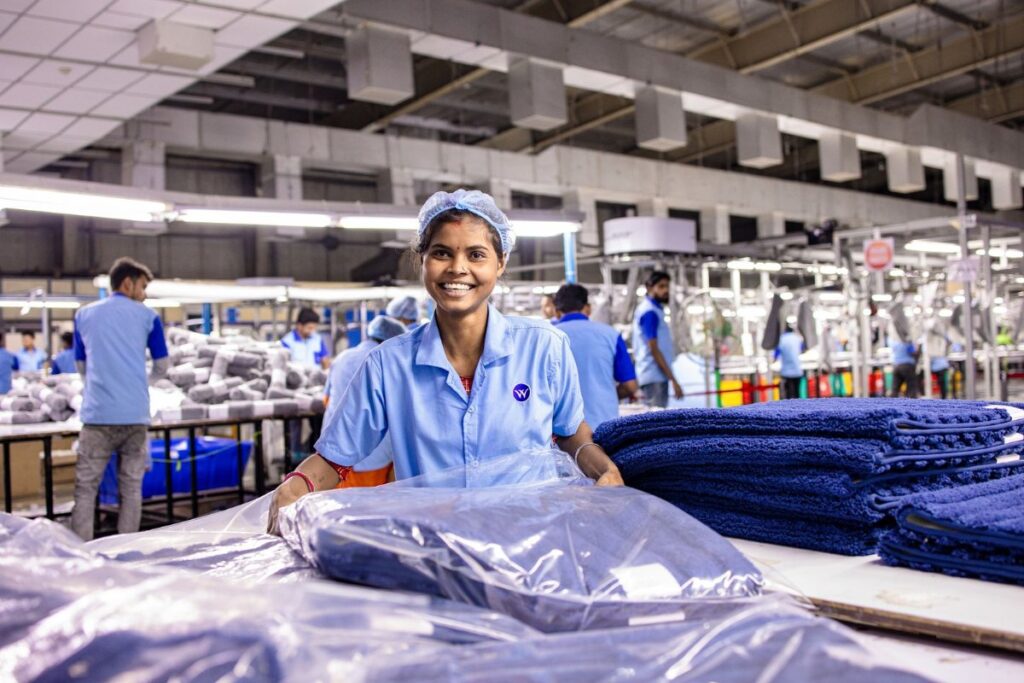
For close to two decades, “China versus India” for textile sourcing was a settled question for most hospitality buyers: China won on price and lead time, India was the fallback for buyers who wanted a second source or slightly more flexible order sizes. That gap has narrowed enough that treating it as settled today is a mistake. It hasn’t flipped entirely — China still leads on raw manufacturing scale — but on the three variables that actually matter for a hospitality linen order (rate, quality consistency, and lead time), the comparison is closer than most procurement teams have updated their assumptions to reflect.
Rate: the gap has narrowed structurally, not temporarily
Chinese manufacturing labour and input costs have climbed steadily for over a decade, a well-documented structural shift rather than a short-term fluctuation. Indian mills, meanwhile, have benefited from the recent removal of customs duty on raw cotton imports and generally lower labour costs, which together have pushed FOB pricing on comparable hospitality-linen SKUs closer than a straight historical comparison would suggest. This isn’t a claim that India is now categorically cheaper — it varies by product category and mill — but the price premium buyers once paid to source from India specifically has shrunk enough that it’s worth re-quoting rather than assuming China wins by default.
Quality: less about country, more about visibility into process
Both countries have mills capable of producing hospitality-grade linen that holds up to commercial laundering. The real differentiator, as with any sourcing comparison, is how much visibility you get into the production and inspection process before the container ships — in-line GSM checks, pre-shipment inspection with an independent agency, documentation that matches what was actually produced rather than what was quoted. Large Chinese factories often run sophisticated internal QC systems built for volume brand orders; established Indian export mills, particularly those used to documentary letter-of-credit terms, tend to build inspection into smaller, more flexible production runs. Neither is universally better — the question to ask a specific mill, regardless of country, is what inspection actually happens and who gets to see the report.
Lead time and order flexibility: where India’s structure helps mid-size buyers
China’s port and logistics infrastructure remains a genuine strength for very large, standardised orders. But for an independent hotel group or a regional hospitality distributor placing an order that isn’t container-scale on a single SKU, Indian mills — especially the SME-heavy clusters around Karur, Solapur, and Erode — tend to offer more flexible minimum order quantities and are generally more willing to accommodate mixed-SKU consolidated shipments. That flexibility matters more to a 150-room independent property replenishing linen on its own schedule than it does to a hotel chain running centralised procurement at scale.
The diversification argument, stated plainly
Independent of price and quality, a meaningful number of hospitality buyers have been actively diversifying sourcing away from single-country dependency on China over the past few years, driven largely by the unpredictability of US-China trade tension and its knock-on effects on global freight and pricing. That’s a risk-management decision as much as a cost decision, and it’s pushed genuine sourcing evaluation toward India that wouldn’t have happened on price alone even five years ago.
The honest conclusion
This isn’t an argument that India has overtaken China as a sourcing destination across the board. It’s an argument that the price and capability gap has closed enough that a comparison run today, on your actual SKUs and volumes, is likely to produce a different answer than the same comparison would have five years ago — and that’s worth checking rather than assuming.