
Most African hospitality buyers comparing sourcing destinations for bed and bath linen start with the same spreadsheet: India versus China versus Pakistan versus a domestic mill, ranked by FOB price per kilogram. It is the wrong first column. A shipment that looks 8% cheaper on paper but arrives with GSM running 15% under spec, or loses its colour after forty commercial wash cycles instead of two hundred, was never actually the cheaper option once you count the re-order, the guest complaints, and the laundry contract renegotiation that follows. The variable that actually separates sourcing destinations is quality control process, not the unit price sitting next to it.
What “quality control” means for hospitality linen specifically
Retail linen and hospitality linen are tested against different failure modes, and buyers who source both categories from the same supplier list often don’t realise the specs quietly diverge. A retail duvet cover fails when a customer is unhappy with it once. A hotel duvet cover fails when it can’t survive a commercial laundry’s 60–70°C wash-dry-press cycle two to three times a week for eighteen months without pilling, shrinking out of size tolerance, or losing GSM to fibre breakdown. That means the checks that matter for a hospitality order are narrower and more mechanical than a general “quality check”: GSM consistency within a tight band (typically ±5%) roll to roll, not just on the first sample; colourfastness to industrial washing and chlorine bleach, not just to light; seam and hem strength under repeated tension; and shrinkage after wash staying within the size tolerance the property specified, not the tolerance a garment buyer would accept.
Where the process actually differs between sourcing destinations
The honest comparison isn’t “Indian mills are better than Chinese or Pakistani mills” as a blanket claim — capable mills exist in all three. The difference that matters is how much of the inspection process a buyer can actually see before the container leaves port, and that varies more by how the sourcing relationship is structured than by country of origin alone. A buyer working through a single trading intermediary with no visibility into which mill actually wove the order typically sees one data point: the sample that was couriered before the order was placed. What happens between that sample and the bulk production run — whether the mill held GSM and colour consistency across the full run, whether a pre-shipment inspection actually happened or was rubber-stamped — is invisible until the container is opened at destination.
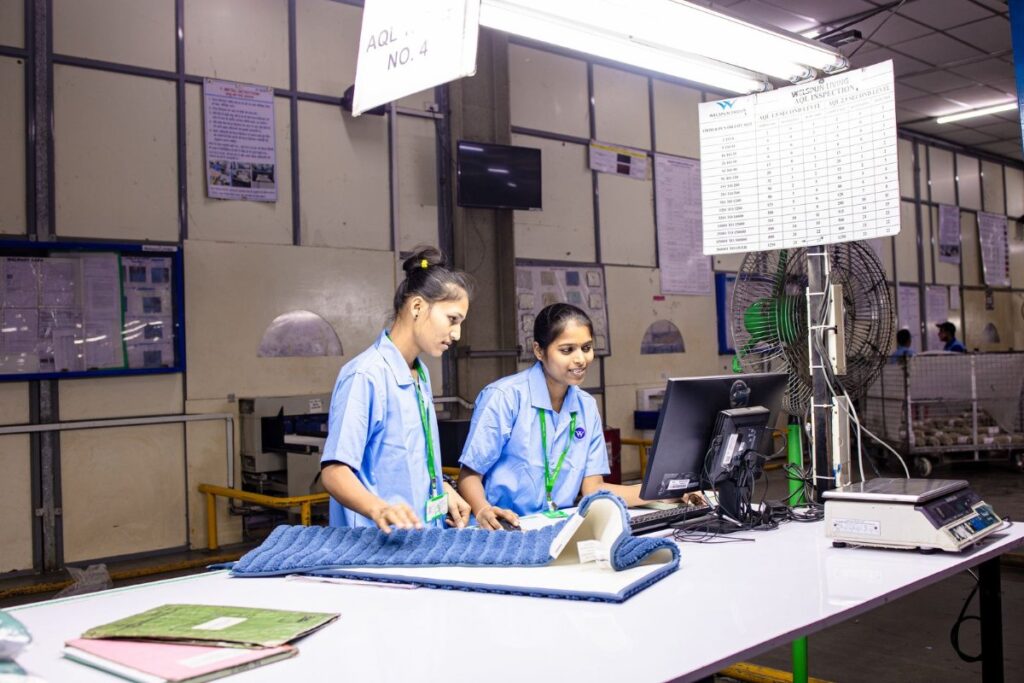
Mills that are used to exporting on documentary letters of credit and export finance, which is common practice among established Indian hospitality-linen exporters, tend to build inspection into the production schedule rather than treating it as an afterthought: in-line checks during weaving and processing, a pre-production sample matched against the buyer’s approved reference, and a pre-shipment inspection with an independent third party — SGS, Intertek, or Bureau Veritas are the names most African importers will recognise — whose report goes to the buyer directly, not through the seller first.
The cost of skipping inspection is asymmetric
Pre-shipment inspection on a container of hospitality linen typically costs a few hundred dollars. Re-ordering a rejected shipment costs the freight twice, the original stock written off or heavily discounted, and however many weeks the property runs short on room linen in the meantime — which, for a hotel, usually means renting from a laundry contractor at a markup while the replacement order is in transit. The asymmetry is the entire argument for building inspection into the order rather than treating it as an optional add-on: the downside of skipping it is a multiple of the cost of doing it.
How Celeris Exim structures this for buyers we work with
Every mill we introduce goes through documentation verification — export track record, IEC and GST status, and references from prior buyers — before we make an introduction. For the order itself, we arrange an independent pre-shipment inspection on request, with the report sent to you directly rather than filtered through us first. That’s a lever most African buyers sourcing through a single agent or trading house don’t currently have, and it’s usually the difference between a first order that becomes a repeat relationship and one that doesn’t.